
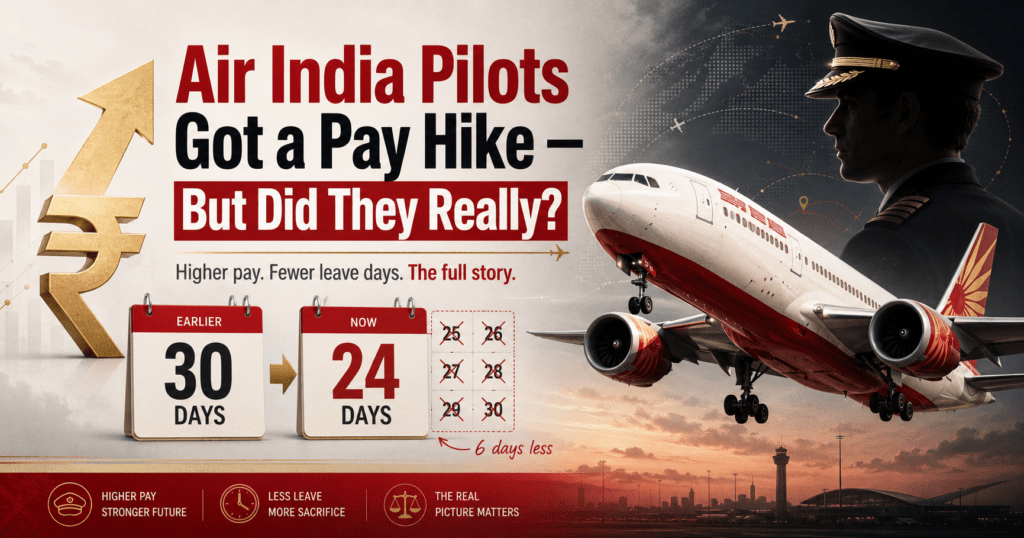
While on a recent flight, I was asked what I thought about the Air India salary hike and what I thought about salaries increasing for the rest of us. That was a long 3 hour long flight and that conversation took up all of our “free” time. So here’s what I think is happening right now and how this affects the rest of us: the aspiring pilot, the young first officer, the experienced first officer waiting for a command upgrade and the comfortable captain and the ranks above.
Let’s start with how much is the salary hike? The increase is being reported in the range of roughly 8 – 15% depending on rank.
On the face of it, this is great news for pilots.
A senior captain flying around 55 hours a month could reportedly see monthly earnings increase from approximately ₹7.5 lakh to ₹8.3 lakh, while First Officers also get a meaningful increase. Flying over time rates beyond the guaranteed 40 hours have been revised, and there are additional incentives aimed at retaining experienced pilots.
So yes, pilots are being paid more. But is this simply a salary hike?
I don’t think so.
In my view, this is a positive development, but it is also largely a restructuring of pilot compensation gift wrapped in some fantastic PR.
And there is one part of the announcement that deserves far more attention than it is getting.
Six Days That Nobody Is Talking About
Along with the salary hike, Air India has reportedly reduced annual Privilege Leave from 30 days to 24 days. Mandatory weekly offs will not be deducted from these leave days, which is certainly an improvement in how leave is accounted for. Thank you Air India.
But the basic fact remains:
Pilots have lost six days of Privilege Leave.
To somebody sitting outside the industry, six days in an entire year may not sound like much.
Ask an airline pilot.
When you do not get weekends off or national holidays.
When you are flying today’s increasingly complex rosters, dealing with early mornings, night flights, changing body clocks, time away from family and sometimes simply trying to recover on your days off, every extra day of genuine rest is priceless.
Leave isn’t just another HR benefit for a pilot. It’s part of the compensation.
If an airline reduces your paid leave and gets additional days during the year on which you can potentially be available for work, then at least part of the additional money being paid has to be seen for what it is:
Compensation for giving the company more of your time.
Suddenly, the headline “15% salary hike” becomes a little more complicated.
Why Is Air India Doing This Now?
This isn’t happening in isolation.
Air India is competing for experienced pilots at a time when losing them has become increasingly expensive.
The Economic Times reports that IndiGo has recruited senior First Officers from Air India Express, while Gulf carriers including Emirates, Qatar Airways and Etihad continue to recruit Indian pilots with attractive salaries and wide body opportunities. Air India is also trying to strengthen its Boeing 737 pilot pool at Air India Express and has reportedly offered transfer incentives of up to ₹21 lakh to eligible pilots.
So I would put the reasons behind this salary revision roughly in this order:
1) Pilot resignations. 2) Poaching from other airlines. 3) Shortage of experienced captains and command ready pilots.
That last distinction is extremely important.
There Is a Pilot Shortage, But Not Where You Think
Whenever news like this comes out, aspiring pilots understandably get excited.
“Airlines are short of pilots!”
“Pilot salaries are going up!”
“India needs thousands of pilots!”
All of those statements can contain some truth while still creating the wrong impression. The real competition today is primarily for experienced pilots: Senior First Officers approaching command, captains, instructors and other pilots who cannot simply be produced overnight.
That does not mean airlines are desperate for fresh CPL holders. In fact, the numbers tell a very different story.
The first six months of 2026 alone have produced roughly as many CPL holders as the average full year over the previous five years.
And the pipeline is only getting bigger.
IndiGo already has a large cadet pipeline, while Air India and Akasa are developing their own cadet programmes. Conventional flight training is simultaneously producing pilots in record numbers.
So when somebody tells an aspiring pilot that India has a “pilot shortage”, my immediate question would be:
A shortage of which pilots?
There is a massive difference between a fresh CPL holder looking for their first airline job and an experienced Senior First Officer who could soon occupy that left seat.
Read my detailed blog on the reality of pilot shortage here.
Will Other Airlines Now Increase Salaries Too?
Possibly eventually.
But I don’t think Air India’s announcement automatically forces any immediate industry wide response.
The reality is that most large carriers already operate within very different fleet structures, utilisation models and roster patterns, so a direct “salary war” reaction is not as straightforward as it looks from the outside.
There has also been a lot of comparison between Air India’s 40 hour contract and higher utilisation models at other airlines.
I don’t think that comparison is completely fair either.
A pilot flying around 40 hours a month is naturally likely to spend more time at home than someone consistently flying significantly higher hours. That means six days of lost leave can have an even greater impact on someone already operating a heavy roster.
Airline pilots across airline operators have experienced changes to their leave structures over time as companies adjust to operational demand. And if you ask most line pilots honestly, they will tell you the same thing:
Once your roster becomes busy enough, time starts becoming as valuable as money.
So Is the Air India Salary Hike Good News?
Yes.
Experienced pilots becoming more valuable and airlines being forced to pay to retain them is ultimately a healthy development.
But don’t read the ₹8-10 lakh salary headlines and conclude that every pilot in India is suddenly sitting in a seller’s market. And don’t look at Air India’s salary increase without looking at what pilots are giving up in return.
The package appears to give pilots more money. It also gives the airline more availability and greater productivity. That’s why I wouldn’t describe it simply as a salary hike.
It is a renegotiation of what a pilot’s time is worth.
And perhaps that is the real story here.
For experienced pilots, the market is finally beginning to recognise their value.
For fresh CPL holders, however, the reality remains very different.
Don’t confuse a shortage of experience with a shortage of pilots.

A true insight into Indian Aviation in the recent years. It’s a play on efficiency as well as usability vs availability of experienced flight deck crew.
The subtle changes (I.e. OFF’s don’t count towards Earned Leave) are rightly brought out. It is surely a progressive step.
Time is PRICELESS for Pilots, irrespective of crew experience ! let that sink in, no matter what contract you are on.
Well written Abdut ! Cheers !