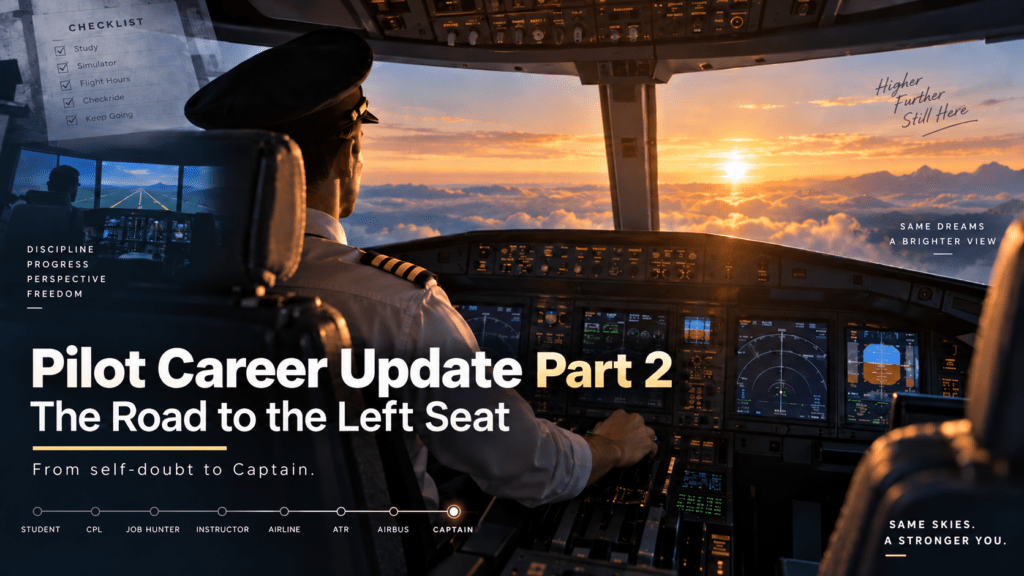
In part 1 of my pilot career update I faced one of my most difficult decisions which ended with me moving from the ATR to the Airbus fleet. At the time, that decision meant giving up an immediate opportunity for command. It wasn’t an easy choice, but it was the right one for me and my family. I knew that Captaincy would come eventually. Click here to read part 1.
At the time, I wrote: “The captain title will come. When the time is right and when I’m right for it.”
About 9 months after being line released as first officer on the Airbus fleet, a simple roster update appeared.
Command assessment. I had about 2 weeks to prepare. And suddenly, everything became very real.
Table of Contents
ToggleStarting Over on the Airbus
When I moved from the ATR to the Airbus, I carried a certain amount of confidence with me. I had experience. I had spent years flying this amazing machine. I knew the airline operations. I wasn’t walking into an aeroplane for the first time in my pilot career.
That confidence lasted until the type rating simulator sessions began. Then I felt like a beginner all over again.
The Airbus was on a completely different level of complexity compared to what I was used to. There was so much happening behind the scenes. Automation itself was a huge learning curve. That one chapter was bigger than the entire ATR manual. There was so much to unlearn from the ATR and then learn it again the airbus way.
It took time to change instincts that had been built over years of flying the ATR in my pilot career.
Take something as simple as descending.
On the ATR, to increase the rate of descent, simply reduce speed and increase the vertical speed. She falls like a rock, no problem.
Try applying that same thinking and slow down the Airbus, and she becomes a glider. Here, you have to increase speed to achieve a higher rate of descent. Plan for it, cause we still have to slow down at some point.
Completely different way of thinking.
Fuel was another change. The ATR was so fuel efficient that fuel rarely crossed our minds. On the Airbus, every minute, every kilogram matters much more.
And this was just the aircraft. Every new destination meant another set of procedures to read. New airports, local restrictions, operational differences. Every flight seemed to teach me something new.
The studying simply never stopped.
Preparing Before the Opportunity Arrived
I knew command could come relatively quickly, so I didn’t wait for the call before preparing for it. For those nine months, I studied whenever I could.
- In the car on the way to the airport.
- On the way home.
- During quiet periods in cruise.
- At home after the kids had gone to sleep.
My wife took over a lot of my responsibilities at home just to give me more time. At one point, those last few days before the exam, she basically told me to lock myself in the room so the kids wouldn’t keep interrupting me.
But preparation wasn’t only about manuals. I had already started watching the Captains I flew with differently.
- Why did they make that decision?
- Why did they speak to somebody in that particular way?
- What were they thinking when the weather deteriorated?
- How were they managing the crew?
- I would ask questions and sometimes role play situations in my head. What would I do if I were sitting in that seat?
In my pilot career, I was fortunate to fly with some excellent Captains. They answered questions, but more importantly, some would let me experiment.
“Try it.” they said. “See what the aeroplane does.”
They would explain what they considered important for the command assessment, what mattered in the interview and more importantly, what mattered once you actually became Captain.
There were also a handful who treated me almost as if I had never flown an aeroplane before. That taught me something too. Every Captain is, whether they realise it or not, is helping to train a future Captain.
Nine months went like this. Study. Fly. Learn. Repeat. Then came that roster update.
The Roster Change
There was no dramatic phone call. I had just woken up after getting home late from a flight. I checked my roster. And there it was.
The command assessment process was starting.
I knew it was coming, yet somehow I was still surprised. My wife was much calmer. “Okay. Good.” she said. That was basically her reaction.
But, my brain had already started running through everything that could go wrong. The question wasn’t whether I had enough experience to be a Captain. The question was whether I had enough experience on this aircraft.
- Did I really know the Airbus well enough?
- Would I pass the written exam?
- What would they ask in the interview?
- Had nine months given me enough exposure?
The harder I studied, the worse this feeling became. There is a strange thing that happens when you study something deeply. Instead of realising how much you know, you start discovering how much you don’t know.
The manuals seemed endless. Hundreds of pages. Systems. Procedures. Limitations. Automation. Operations. Company Manuals. Every answer seemed to reveal more questions.
Then, two days before the exam, a friend who was scheduled for the same date as me, told me he wasn’t going. He didn’t feel ready. He wanted a few more months to study.
And suddenly that sounded like a very sensible idea. Maybe I should do the same. Maybe a few more months would make the difference. Maybe I wasn’t ready either. The self doubt went through the roof.
My wife gave me the simplest advice.
Just go. Pass or fail, you will at least have experienced the assessment and know what to expect next time. It didn’t make me any less terrified. But it convinced me to show up. Sometimes that’s enough.
“Fuck It.”
The day before the exam I was still desperately trying to go through everything one final time. One manual became another manual. Then another.
There simply wasn’t enough time. Each one had hundreds of pages and I was trying to somehow fit months of knowledge into one final day.
Eventually my brain had enough. I remember reaching this point where I thought:
Fuck it.
They can ask whatever they want. I’ll answer what I know. I closed the books. That might have been one of the
most useful things I did.
The next day, I wrote the exam. It wasn’t easy. By the end I felt reasonably confident that I had passed.
As we waited for the results, we started discussing answers. Some of the other pilots had been flying the Airbus for many years. Some had more than 4,000 hours on the aircraft. Their answers to a few questions were different from mine.
My confidence disappeared again. Maybe I had misunderstood something. Maybe nine months really wasn’t enough.
About an hour later the results came. I passed.
It was a useful reminder that experience and preparation are not always measured by the number printed in your logbook.
The Interview
There wasn’t much time to enjoy passing the exam. A couple of hours later came the interview.
Training Captains from management sat across the table. There were technical questions, scenarios, decision making exercises and questions designed to understand how much I understood the Airbus and how I would manage it as a Captain.
And just before going in, all those thoughts started again.What if they ask this? Do I remember that? What if I get something completely wrong?
But something changed during the interview. It became conversational. It started with the fact that I was from the ATR and my little experience on the Airbus. “So, which aircraft do you like more?” How would you answer this? Me? I was honest. ATR. I said.
The years of actual flying started becoming more useful than the extra paragraph I could have studied from a manual. Decision making comes from experience. Leadership develops through experience. Knowing an aeroplane is obviously important, but command is about far more than reciting systems knowledge.
At the end, one of the Captains said something I will not forget. He told me that he was not only happy with how the interview had gone but that nobody with my level of experience on the aircraft had answered the way I had.
I don’t mention that to sound smug. I mention it because, after weeks of convincing myself that I didn’t know enough, that was probably the first moment when I thought:
Maybe I actually do belong here.
I went back to the hotel feeling relieved. The difficult part was done.
Or so I thought.
Roster Update Again
Just a few hours after getting back to the hotel came another roster change. The Simulator Check. The very next night.
All the stress came rushing straight back. Until then almost all my attention had been on the written exam and interview.
Now I had one day to switch gears completely.
- ECAM Handling.
- Failures.
- Raw data flying.
- CRM.
- Decision making.
Technical knowledge wasn’t going to be tested on a piece of paper anymore. It was going to be tested while things were going wrong around me.
That was a long night. I had to adjust my body clock too.
The following night, as I got into the simulator I was nervous. Although strangely not as nervous as I had been before the exam and interview.
The first failure came. I dealt with it. And somewhere after that I remember thinking: Okay. This is going alright.
After that I was calm and methodical.
The assessment phase was over. Now the actual work could begin.
Learning to Become Captain
Passing the assessment didn’t make me a Captain. It only gave me permission to start training to become one.
What followed was roughly:
- A month of ground school.
- Then 15 simulator sessions. Including 2 skill test sessions.
- Then approximately 100 hours of flying as Acting Captain under the supervision of a Training Captain.
- Then 10 check flights with Designated Examiners.
- The final company line release check.
Only after all of that would I finally be released as a line Captain.
The simulator phase was probably where I was reminded again just how much there was still to learn. Many failures were things I was seeing for the first time. You had to understand the technical problem, understand what the aircraft was doing, manage the crew, make decisions and still continue flying the aeroplane. You had to adapt very quickly.
Sim sessions three and four were probably the hardest for me. The doubts returned. Was I really good enough?
But you move on. You learn. Then you come back for the next session. By the time the skill tests arrived, there was confidence to deal with any situation. Eventually the simulator training ended and it was time to fly the actual aircraft from the left seat.
Although we had already practised everything in the simulator. Normal procedures, Abnormal procedures, Emergency Procedures, an actual aircraft is different.
For the first few seconds, seeing the passengers behind you makes everything suddenly very real. These aren’t simulator seats anymore. There are actual people sitting behind that cockpit door.
The feeling was daunting. For a few seconds. Then you start working. And everything else fades away.
“I’ll Look Out the Window.”
The Training Captain I was with on day one, made the rules very clear.
“You are in charge. If you look at me for answers, I’ll look out the window.”
Message received. From that point onwards, the decisions were mine. Of course, there was a Training Captain sitting beside me and I was still under supervision. But mentally, I had to operate as Captain.
That meant making decisions instead of waiting for somebody else to make them. It also meant learning when and how to use CRM properly and to my advantage. Being in command doesn’t mean knowing everything. It means using all the resources available to you while understanding that, ultimately, somebody has to make the final decision.
And now that somebody was me.
There was no magical moment when I would suddenly feel like a captain. The responsibility was given to me, and I had to rise to it.
My training took place during the monsoon, so weather was a factor almost every day. Every sector brought decisions and something new to learn. By around 65 to 70 hours, I genuinely felt ready.
After more than 100 hours and 40 flights, came the final stage. Ten route checks.
Failure in any one of them means you have do extra training flights and then starting the 10 route checks again. The first one naturally came with apprehension. Then they became easier. Not because the standards changed, but because my mentality changed. I stopped thinking about being assessed every second and simply did the job.
Nine checks went by without any drama. Then came number ten. The final one.
It Had to Be the Last One
My entire pilot career came down to that final check. Any mistake and you go back and start the checks again. So naturally, after nine relatively uneventful flights, there were jitters on that last one.
It was close to midnight, after almost 3 hours of flying, making my last approach, I had to perform a go-around. Probably not what anybody wants when being evaluated on their final check. But a go-around is not a failure. Quite often, it is exactly the opposite. It is the safest decision available when an approach isn’t developing the way you want.
But is the examiner thinking the same thing? What if this was below standard for him? All these doubts suddenly flood my mind. Then I have to come back and say to myself, pass or not is a problem to deal with after parking. For now I still have to finish my job. So I start a quick briefing with the examiner, check the fuel remaining, discuss the approach again and tell ATC we’re ready for another approach.
Second approach and all the way down I’m thinking “don’t muck it up again”, “don’t muck it up again”… Short finals and I have to say to myself again, come back and fly now, we’ll deal with what happened after parking.
Touchdown. Runway vacated. “Okay not a hard landing”, ” Within the touchdown zone”, “On the runway centerline”, “Everything by the book”. I am happy with that one.
A few minutes later we park the aircraft and get done with the post flight paperwork. The examiner looked at me and simply said:
“Well done. You’ve passed.”
That was it! Seventeen years of uncertainty, study, flying, not flying, career decisions, setbacks, different countries, different aircrafts and countless hours wondering where all of this was eventually going. And the moment itself came down to four words.
Well done. You’ve passed.
It was very late by then. I sent a message to my wife. Another to my parents. Then I went home.
There was no big celebration. I slept.
And after what felt like years of constantly thinking about the next exam, the next training course, the next assessment or the next uncertainty, I had one of the most peaceful nights of sleep I can remember.
That was my celebration.
Final Approach - Seventeen Years Later
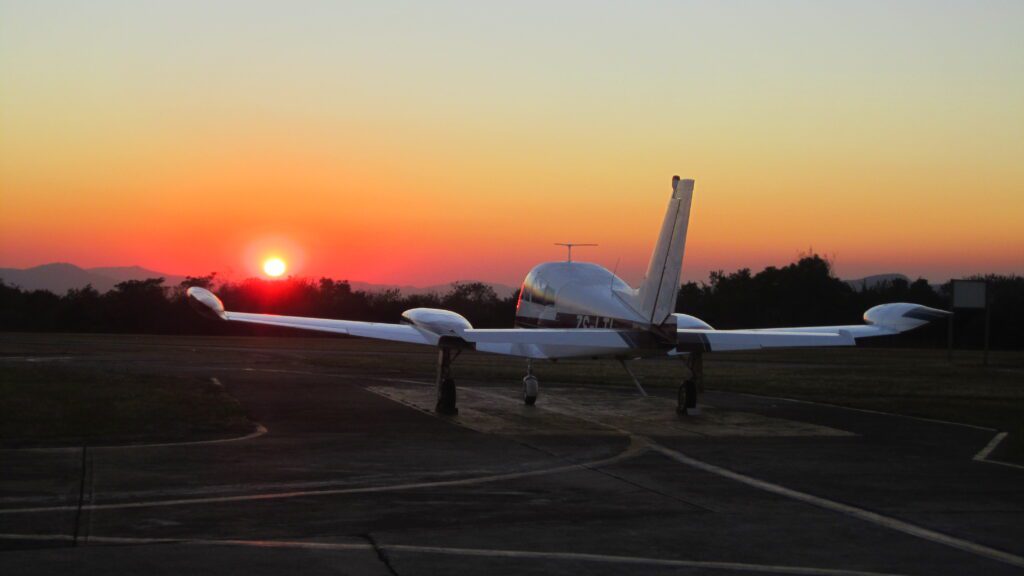
It took a few weeks for my PIC endorsement to come from the DGCA. Classic huh!? After that was that final company line release check. Although there’s no real pressure on this one, it all comes down to this. The last 2 flights with a trainer. As I started my descent on the last flight, my mind went over that first flight of mine in South Africa, back in 2009. Then my first solo, and first solo navigation flight, then my PPL, night rating, instrument rating, CPL, instructor’s rating, and so on. All super achievements. All well celebrated. But all seemed so miniscule compared to what is coming.
Looking back, becoming Captain isn’t the only thing I feel proud of. I’m proud of my entire pilot career. I’m proud that I stayed with aviation through the periods when it would have been very easy to walk away. I’m proud that I got through the setbacks.
And I know very clearly that none of it happened alone.
My family absorbed a lot of the cost of this journey. My wife took over responsibilities while I studied. My children had days when Dad was physically at home but sitting behind a closed door with manuals. When I had to be away living in a hotel for months together for training. My parents who had put in so much money, sold jewelry, had to listen to society during those unemployed days.
Those sacrifices don’t appear anywhere on a pilot’s licence. But they are very much part of the qualification.
If there are two things I have learned from this journey, they are these:
Be prepared for an opportunity before it arrives.
I had only 17 or 18 days between seeing that roster update and sitting for the assessment. The real preparation had happened during the nine months before that. When there was no exam date and nobody had promised me anything.
And secondly:
Your career does not have to happen according to somebody else’s timeline.
If you have read part 1 then you’ll know all the possible decisions I could have made differently and all the possible ways in which my career could have ended up differently. There is rarely one correct career path that applies to everybody.
Part 1 of this story was filled with uncertainty about where my career was going. Part 2 ends in the left seat of an Airbus.
But strangely, it doesn’t feel like an ending.
Seventeen years to get to the left seat. And somehow, it still feels like we’re only at the interval.
There is always more to learn, another experience around the corner and another chapter that I don’t know anything about yet. So perhaps this isn’t the conclusion after all. Let’s hope part 3 is just as exciting.
These are of course just my opinions based on my experiences and gained knowledge. Differences in opinion are welcome.
Looking for a pilot career? Visit the Contact Me page and book a consultation and plan your career with clarity.

About the author: Abdut Ghiya is an airline pilot and former flight instructor with nearly two decades of aviation experience. He completed his initial flight training in South Africa, later worked as a flight instructor and freelance pilot in South Africa and then the Philippines and is currently an airline captain in India. He writes about pilot training, airline careers and the practical realities of a professional pilot.