

How much does it really cost to become a commercial pilot in India? The answer is not simply a price quoted by a flight school.
It depends on whether you choose a cadet program or conventional CPL training, training in India or abroad, pay for the training yourself or take a loan and whether you need to pay for a type rating, the final amount can vary enormously.
More importantly, the real cost of becoming a pilot does not end when your training finishes. You may have loan interest, licence conversion expenses, accommodation, additional training, type rating costs and a period without income while waiting for your first job.
That is the part I believe aspiring pilots and their families need to think about before committing such a large amount of money.
In this article, I will break down the major training costs, show what a ₹50 lakh or ₹1 crore loan actually looks like over time, and discuss how long it may realistically take before you recover your investment.
There is no single number that applies to everyone. Your training route, financial situation and tolerance for risk are different from somebody else’s. The objective is therefore not to tell you that becoming a pilot costs exactly ₹X.
It is to help you calculate what becoming a pilot could actually cost you.
Table of Contents
ToggleAll the Costs Involved in Becoming a Pilot
There is no standard price for becoming a pilot in India. The final cost depends on the training route, flight school, country, how efficiently you complete your flying and what is included in the package from the flight school or cadet program. I will give an average estimate just for your understanding but totals will very depending on the choices you make.
1. Medicals, DGCA exams, applications and licensing: ₹2 lakh
This includes expenses such as Class 1 and Class 2 medicals, DGCA examination attempts, RTR/FRTOL, licence applications and other smaller administrative expenses. Individually they may not seem significant, but together they add up.
2. Ground School: ₹2 to 3 lakh
If you choose conventional flight training in India or even a cadet program, most students will use a ground school to prepare for the DGCA exams. If you are training abroad, my personal approach to DGCA exams is different, which I have explained in my foreign CPL conversion guide.
3. Conventional CPL Flight Training: approximately ₹50 to 65 lakh
This is where most of your money is spent. The actual figure depends on the flight school, whether you train in India or abroad, how fast you complete the course and whether accommodation and multi engine training are included. Here’s a guide on how to find the best flight school.
4. Cadet Pilot Program: approximately ₹1 to 1.8 crore
Cadet programs cost substantially more, but they also usually include more of the training and costs towards the airline, such as CPL training, licence conversion and type rating. The exact figure varies enormously between airline programs, training partners and countries. Always check what is actually included before comparing a cadet quotation with conventional training. Here’s my guide on comparing the 2 training methods.
5. Foreign CPL Conversion: approximately ₹4 to 6 lakh
If you train abroad, budget for converting your foreign CPL to an Indian DGCA CPL. The actual amount depends heavily on how well you planned your flying before returning to India. Completing the necessary recency flying abroad can save both money and time as the preceding 6 month flying requirement takes the bulk of the cost here.
6. Type Rating: approximately ₹12 to 20 lakh
This applies mainly to conventional CPL holders who decide to self fund a type rating. I am referring here to enrolling directly with a Type Rating Organisation, not the much higher prices sometimes advertised through flight schools, cadet programs or intermediaries.
More importantly, a type rating is not something I would automatically add to every conventional CPL budget. Whether you should spend this money depends on the employment opportunities available at that time, when completing your CPL.
7. Additional Airline Training / Refresher: ₹5 to 12 lakh, if applicable
If you already hold a type rating but it has expired or does not completely meet the airline’s current requirements, you may have to pay for refresher training, differences training or additional simulator sessions. This will vary considerably between airlines and your individual circumstances, so do not automatically assume this expense will apply to you.
8. Flight Instructor Rating: ₹8 to 12 lakh
If you decide to become a flight instructor instead of immediately pursuing an airline type rating, there will be an additional training cost. I personally believe instructing can be an excellent way to begin a flying career because you gain experience while getting paid rather than continuing to spend money just to sit at home awaiting the airline job.
9. Living, travel and unexpected expenses: keep at least a 15% buffer
Flight tickets, visas, accommodation, food, transport, additional flying, examination attempts, delays and the US dollar exchange rate changes can push your final expenditure well above the quotation you originally received.
So What Is the Total?
There isn’t one number.
A conventional CPL holder may spend roughly ₹50 to 65 lakh and wait before spending anything further.
Another may add a ₹15 lakh type rating and push the investment towards ₹70 to 80 lakh.
A cadet may commit ₹1 crore or considerably more to a more structured airline linked pathway.
Another pilot may complete a CPL, become an instructor, build experience and eventually join an airline without ever paying for their own type rating.
That is why the real question is not “How much does it cost to become a pilot?” It is “How much will the route I choose cost me before I start earning?”
What A Loan Actually Looks Like
If you are taking a loan for pilot training, the course fee is not your final cost.
Educational loans in India typically offer a maximum of ₹7.5 lakhs without collateral. The average Rate of Interest on such loans is around 11%. In the case of a personal loan, this rate can be as high as 14%. For example, we’ll assume a rate of 11% and calculate the repayment based on the maximum tenure of 15 years for an education loan. You can google an EMI calculator and play with the numbers.
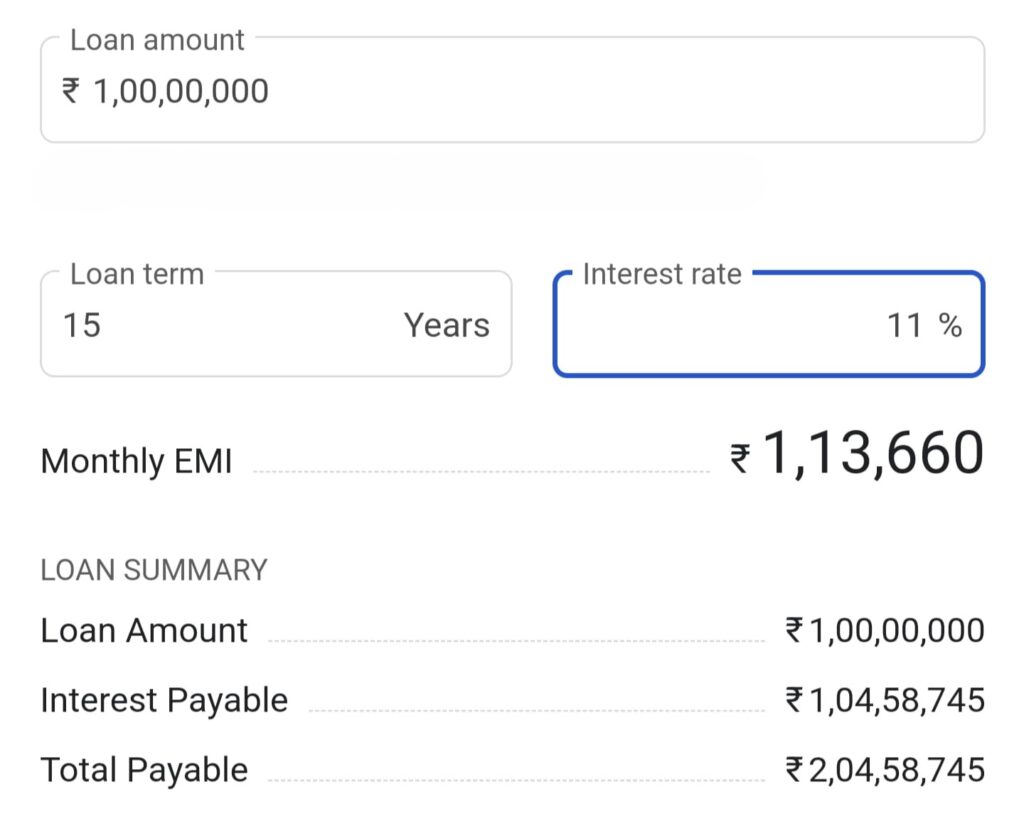
The monthly repayment for a ₹1 crore loan at 11% interest over 15 years is ₹1,13,660. Over the course of the loan, you would not only repay the principal ₹1 crore, but also ₹1,04,58,745 in interest, bringing the total repayment to ₹2,04,58,745. The key question is: Is this investment worth it?
Similarly, let’s assume a loan of ₹50 lakhs at the same interest rate and tenure. The EMI would be ₹56,830, and the total interest repaid would amount to ₹52,29,372, making the total repayment ₹1,02,29,372.
Keep in mind that this is just the loan repayment and not the total training cost.
I’ve found this amazing tool to calculate student loan repayments with some other features. Credit to reddit user ineedamercrdes. Click Here.
A family that can comfortably self fund a ₹1 crore cadet program is making a very different decision from a family taking a large loan against their home to fund even a conventional CPL.
Do not only ask, “Can we arrange the money?” Ask, “Can we comfortably repay it if the first airline salary takes longer than expected?”
Pilot Salaries: The Numbers Can Be Misleading
You will often see pilot salaries talked about at ₹8 to 10 lakh per month or more. Those figures can be real, but they usually represent experienced Captains, not someone who has just completed pilot training.
A broad airline career progression may look something like this:
| Approx. Career Stage | Broad Timeline | Approx. Monthly Pay |
|---|---|---|
| Trainee/Junior First Officer | First 6 to 18 months | ₹50,000 to ₹1.5 lakh |
| First Officer | ~1.5 to 3.5 years | ₹1.5 to ₹2.5 lakh |
| Experienced/Senior First Officer | ~3 to 5 years | ₹2.5 to ₹3.5 lakh |
| ATPL/Command Eligible First Officer | ~4 to 6+ years | ₹3 to ₹5 lakh |
| Captain | Often 5 to 8+ years, sometimes much longer | ₹6 to ₹8 lakh |
These are broad figures, not guaranteed salaries or timelines. Airline contracts, aircraft type, flying hours, allowances, seniority and company expansion, etc can change both.
The important point is that you do not finish your CPL and immediately start earning Captain level money.
Even becoming eligible for command does not mean you immediately become a Captain. You need the required experience, company eligibility, seniority, vacancies and successful completion of the upgrade process.
So when somebody tells you: “Pilots earn ₹8 lakh a month.”
Ask: At what rank, after how many years, before or after tax?
The large salaries exist, but for most pilots they come much later in the career.
How Long To Recover Training Cost
This is another area where I think people use unrealistic calculations. This is where the much talked about pilot salaries can become misleading.
If you spend ₹50 lakh on training and later earn ₹2 lakh a month, it does not mean you recover your investment in roughly two years. For financial planning, I would rather assume a worst case but realistic scenario than build the calculation around everything going perfectly. Life is rarely perfect.
Let us assume you finish training and then have to wait 2 years for your first airline job. This is very realistic. Once employed, I will use the lower end of the salary ranges and the longer timeline for each increment:
-
₹50,000/month for the first 1.5 years
-
₹1.5 lakh/month for the next 2 years
-
₹2.5 lakh/month for the next 3 years
Over those first 6.5 years of airline employment, you would earn approximately ₹1.35 crore before tax.
Sounds impressive. All loans repaid?
But remember that you already waited 2 years before earning anything. So you are now roughly 8.5 years after completing your training.
And ₹1.35 crore earned is not ₹1.35 crore recovered. Your salary is not your return on investment. Your savings after expenses are. What matters is how much money you can actually save every month.
After the salary comes taxes, rent, food, transport, everyday expenses and loan EMIs, amongst other things. You may want to live a certain lifestyle. As the years pass, expenses usually increase too. You may get married, have children, support ageing parents, buy a home or simply have responsibilities that you did not have when you started training.
Pilot salaries have not really increased over the years. They have only gone down since it’s peak in around 2011, especially when compared to rate of inflation. So as the years pass, the buying power of your salary actually reduces.
Only what remains after all of this can actually be considered money available to recover your original investment.
So even recovering a ₹50 to 60 lakh training cost can realistically take close to a decade or more from the time you finish training.
If you have taken a loan of ₹1 crore for a cadet program, the calculation becomes far more demanding. On the 15 year loan example above, you could still be repaying the training cost for many years after your salary has increased.
So, the point here is that when you have your own unique number for pilot training, you can use the information above and get a rough estimate for how many years until you recover your money. Just remember to take the worst case scenario cause life rarely works out perfectly as planned. This will save you some headache.
So, Is It Worth it?
This is where the answer becomes personal. By now you should have a reasonably realistic idea of three things:
-
How much your chosen training route may actually cost
-
What your loan and EMI could look like
-
How long it may take before you recover that investment
Now comes the question only you can answer: is it worth it?
Before committing the money, sit down with whoever is funding your training and ask:
- What will the EMI be after training?
-
Can we manage the EMI even if I do not earn for 2 years after training?
-
Are we putting our home, retirement savings or other essential family finances at risk?
- Am I depending on Captain level salary figures to justify the investment?
- What happens if I temporarily lose my medical or training is delayed?
-
If training costs 10 to 15% more than planned, can we absorb it?
-
Am I comfortable carrying this debt into the years when I may get married, have children or need to support my parents?
-
Am I choosing the more expensive route because it genuinely suits me, or because I have been sold the idea that it guarantees a faster airline career?
- Would a lower cost training route materially reduce my financial risk?
The important thing is to enter this career with your eyes open.
Someone who can comfortably spend ₹1 crore is making a very different financial decision from someone borrowing ₹1 crore against the family home. The career may be the same, but the risk is not.
You need to sit down and have an honest conversation with the person who is going to be sponsoring or repaying your loans.
I love flying and aviation has given me a career I value greatly. But passion does not make a bad financial decision good.
Work out the numbers honestly. Understand what happens if things take longer than planned. Then decide whether the investment is worth it for you.
I do not believe pilot training should be evaluated only on whether the eventual salary is high enough.
Remember that these answers are going to be unique to you. Someone might be able to take this burden while some others may not.
This answer that you arrive to will tell you if this investment is going to be worth it. Atleast financially!
The other factors to judge if the pilot life is worth it or not needs a different page for itself, but please read this article from ThePrint.in as an example to get a better idea about the reality of this profession.
Be aware that social media does not talk about the struggle, but just glorifies the profession leading to an unfair assessment. I encourage you to read about all the aspects, the positives and more importantly the negatives before you invest huge amounts of money.
Final Approach
Becoming a pilot can be an excellent career, but the financial side deserves the same amount of thought as the flying.
Do not look only at the CPL training fee or the highest Captain salary. Look at the entire journey: training, conversion, type rating, loan interest, the possibility of waiting for employment, the lower salaries at the beginning of the career and the responsibilities that build up as life moves on.
A ₹50 lakh route and a ₹1 crore route can both eventually lead to the same airline cockpit, but the financial risk involved can be completely different.
My advice is simple: choose the route that gives you a realistic chance of achieving your goal without putting your family under unnecessary financial pressure.
There will always be uncertainty and risk in aviation. You cannot control hiring cycles, aircraft deliveries or how quickly an airline gives you an opportunity. What you can control is how much financial risk you take before that opportunity arrives.
These are of course just my opinions based on my experiences and gained knowledge. Differences in opinion are welcome.
Want to discuss your finances? Visit the Contact Me page and book a consultation and plan your career with clarity.
Very good read 🙂
Your blog provides an honest, detailed, and much-needed breakdown of the financial realities involved in becoming a pilot, which is often overlooked in discussions glamorizing the profession. The emphasis on personal financial planning and real-world salary expectations is practical. You’ve done well to explain the variables that affect training costs and future earnings, making it relatable for readers from different backgrounds. The inclusion of loan structures, repayment timelines, and cost-recovery scenarios paints a realistic picture of the long-term commitment required (Is it really worth it at the end). Overall, this piece serves as an important guide for aspiring pilots and their families to make decisions.
You’re such a good blogger. So much to learn from people like you
An absolute eye opener and true facts…thank u….truly appreciate it
It was an eye opening message. Thank you for that. When flying is the passion it is worth a try. After all you have to try and then only can find out if it works for you. All the statistics said by you is correct to the core.
Thank you. Genuinely appreciated.
Fantastic, This is one place reference for all most all information a beginner needs. Thanks a lot for your fair efforts to keep all the content in well organized manner. I recommend every aspirant to use this blog for honest single source of information.
This is such a good blog series, incredibly useful for new aspirants like myself.
Pingback: Top Vacancies in the Aviation Industry 2026: Careers, Roles & Opportunities – Site Title